Small Living Room Lighting Ideas
A practical step-by-step guide to small living room lighting ideas, including preparation, instructions, common issues, tips, and next steps.
Small Living Room Lighting Ideas
Lighting a small living room well means layering three types of light: ambient, task, and accent. This guide shows you how to place each type so the room feels bigger, works better, and looks warm without adding clutter or glare.
Fast Answer
- Best approach: Layer table lamps, floor lamps, and wall lights at different heights
- Main caution: Do not rely on one overhead ceiling light; it flattens the space
Before You Start
- Measure your room: length, width, and ceiling height in metres
- Sketch or photograph each wall so you can mark where sockets and light switches sit
- Collect your light sources: table lamps, floor lamps, wall lights, and any existing ceiling fittings
- Check bulb types and wattages so you know how bright each light can go
- Set a budget for any bulbs, extension leads, or new lamps you may need
Step-by-Step Instructions
Step 1: Map your existing sockets and switch positions
Walk around the room with your sketch and mark exactly where each socket and switch is. Include the ceiling light switch and any dimmer controls. This map tells you which corners can take a plug-in lamp and which walls would need an electrician for hardwired wall lights.
For a small room, you usually need at least two or three separate light sources to avoid shadows. If your room only has one or two sockets, plan to use a floor lamp near the main seating area and a table lamp on a side table or shelf. Extension leads are fine, but keep them flat against the skirting board and never run them under rugs.
Step 2: Choose your main light source first
Your main light is the one that fills the room with a comfortable, general glow. In a small living room, that is rarely the ceiling light on its own. Instead, choose a floor lamp with a shade that directs light upward or a table lamp with a wide, light-coloured shade. This bounces light off the ceiling and walls, which makes the room feel taller and softer.
Position the main light in the centre of the room or close to the main seating area. Aim for the top of the shade to sit around 150–170 cm from the floor. This height spreads light evenly without blinding anyone sitting down.
Step 3: Assign task lighting for reading and hobbies
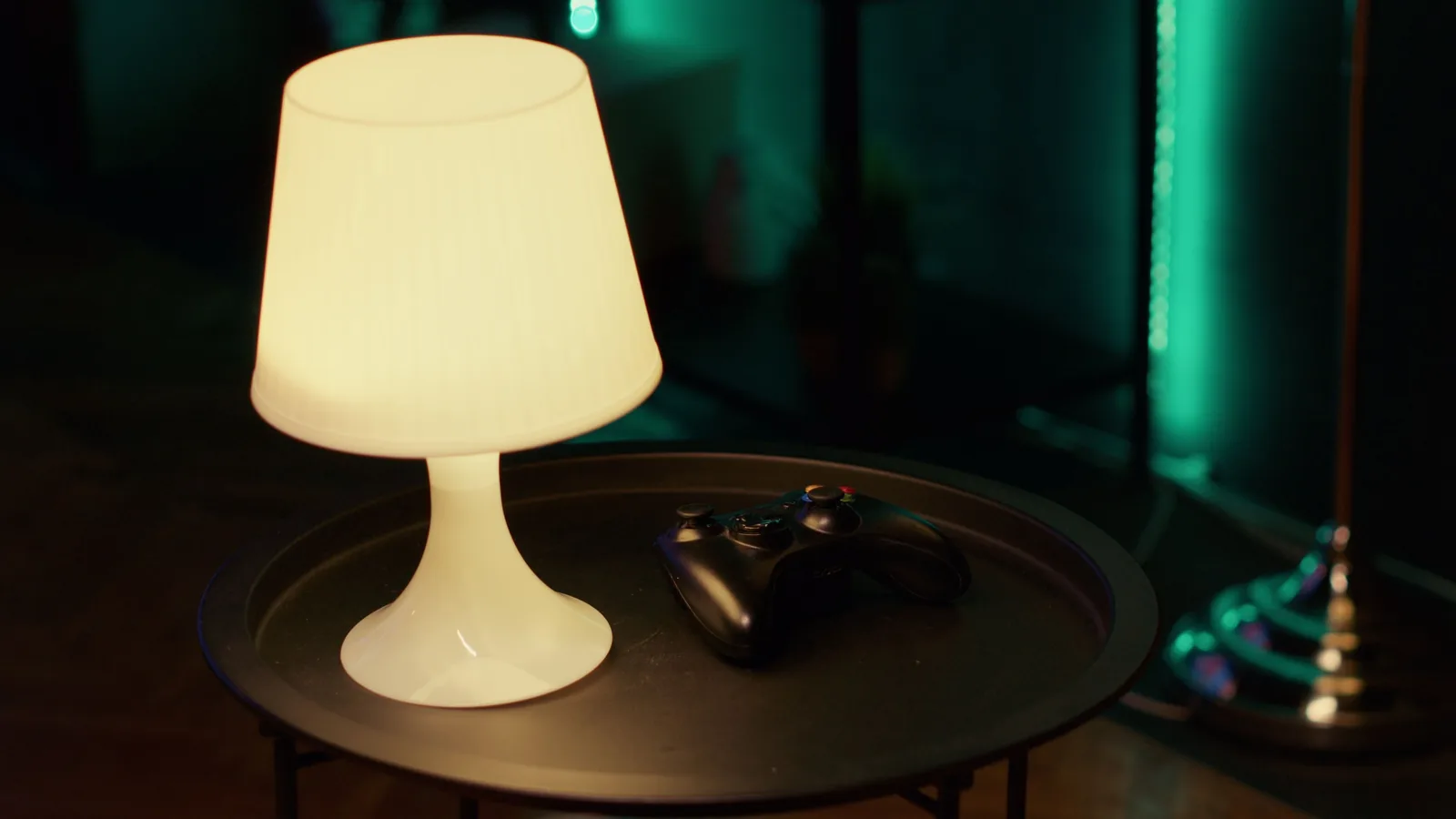
Task light is the one that helps you see clearly when you read, knit, or use a laptop. A table lamp on a side table next to your chair or sofa is the simplest option. Position the lamp so the shade is at or slightly below eye level when you are seated, around 60–90 cm from the floor.
If your armchair is far from a socket, a floor lamp with an adjustable arm works well. Point the light directly at your book or craft, not at your face. This reduces eye strain and keeps the rest of the room gently lit.
Step 4: Add shelf or wall lights to save floor space
Wall lights and small shelf lights take up zero floor space, which matters in a compact room. Mount two wall lights on either side of a mirror or a piece of wall art to bounce light into the room. This creates depth and makes the walls feel like they are further apart.
For a rented home where drilling is not allowed, use plug-in wall lights with a cable that hides behind furniture. You can also place a slim LED light strip along a shelf edge, but keep it facing downward so it does not glare in your eyes. Wall lights work best at 150–180 cm from the floor.
Step 5: Layer accent lighting for depth and drama
Accent light highlights a specific feature, like a plant, a photo frame, or a textured wall. Use a small spotlight or a table lamp with a narrow beam to shine on one object. This draws the eye past the edges of the room, making the space feel larger.
Place the accent light at the back of a shelf or behind a plant to create a soft halo. The goal is to create one or two focal points, not to flood the whole room. Keep accent lighting subtle so it never competes with your task or main light.
Step 6: Balance light heights across the room
Walk around your room and check the height of every lit shade or bulb. You want a mix: some at 60–90 cm (table lamps), some at 150–170 cm (floor lamps), and some at 180 cm or higher (wall lights or ceiling fixtures). This spread stops the room from looking flat and keeps every corner usable.
If all your lights sit at the same height, the room will feel like a corridor. Move a lamp onto a taller shelf or swap a table lamp for a floor lamp to create variety. Also check that no shade sits directly in your line of sight when you sit on the sofa or chair; adjust the shade angle or raise the lamp to avoid glare.
Step 7: Switch to dimmers or smart bulbs for flexibility
A dimmer switch on your main light or a smart bulb in your lamps gives you control over the mood. Bright light works for cleaning and daytime tasks; dimmed light suits evenings and film nights. In a small room, dimming is the fastest way to change the feel without moving anything.
If you rent and cannot change the switch, choose smart bulbs that connect to an app or a remote. Many let you set schedules, so the room lights up just before you get home. Use the lowest comfortable setting for evening relaxation, usually around 20–30% brightness.
Step 8: Reflect light with mirrors and pale surfaces
Mirrors are the cheapest extra light source you can add. Place a mirror opposite a lamp or window so it bounces light across the room. A large mirror on one wall, around 90–120 cm wide, opens up the space and doubles the light you already have.
Pale lampshades, light-coloured walls, and matte surfaces does not absorb light the way dark finishes do. Swap a dark lampshade for a white or cream one to gain extra brightness without buying a new bulb. Keep the bulb visible through the shade if you can, so more light escapes.
Step 9: Test your layout at night and during the day
Lighting changes with the sun, so test your setup in both daylight and darkness. In the daytime, you may only need one lamp for a dark corner. At night, you need the full layer of ambient, task, and accent light. Switch every light on and walk around to check for blind spots, glare, and awkward shadows.
Sit in each seat and confirm you can see the person across the room without squinting. Adjust shade angles and bulb positions until the room feels balanced. This final test takes about 15 minutes and helps you avoid living with a layout that is annoying later.
Quick Reference
| Situation | Use this | Why |
|---|---|---|
| Reading in an armchair | Adjustable floor lamp beside the chair | Directs light onto the page without glare |
| Rental with no wall drilling | Plug-in wall lights or battery-powered lights | Adds light without damaging walls |
| Small room with low ceiling | Wall lights aimed upward | Bounces light up, making the ceiling feel higher |
| Dark corner behind the sofa | Table lamp on a narrow shelf or console | Fills the void without taking floor space |
| Film night or evening relaxation | Dimmer switch or smart bulb set to 20–30% | Cuts glare and sets a cosy mood |
| Room feels flat and dull | Mirror opposite a lamp | Reflects existing light across the room |
Common Problems When You Light a Small Living Room
- One overhead ceiling light makes harsh shadows. Fix this by adding a floor lamp and a table lamp so the room has three light sources instead of one. Even a single extra lamp changes the balance.
- The room still feels dark despite many lamps. Check the bulb brightness. A 2700K bulb at 400 lumens is fine for mood, but you may need 600–800 lumens for a small room to feel bright. Also check whether lampshades are too dark or thick; a cream or white shade lets far more light pass.
- Lamps take up too much floor space. Move one lamp onto a shelf or install wall lights. A single wall light beside a sofa can replace a bulky floor lamp.
- There is a dark corner behind the TV. Place a slim table lamp or an LED strip along the back edge of the TV unit. This fills the space without adding furniture.
- LED bulbs flicker or buzz on the dimmer. This usually means the bulb is not compatible with your dimmer switch. Swap to a bulb marked as dimmer-compatible, or replace the dimmer with a modern LED-friendly model.
- Cables trail across the floor and look messy. Tuck cables along skirting boards and door frames using cable clips. Use a multi-socket extension with a switch so you can turn off multiple lamps with one action.
Advanced Tips for Small Living Room Lighting
Once the basics are in place, you can push the lighting further with a few thoughtful extras.
- Layer light on three planes: low light at 60–90 cm, mid light at 150–170 cm, and high light above 180 cm. This vertical spread makes a small room feel taller and more spacious.
- Use a light-coloured rug and pale furniture. Light surfaces reflect light, while dark surfaces absorb it. A pale rug under your seating area can add noticeable brightness.
- Choose bulbs with the same colour temperature across all lamps. Mixing cool white and warm white bulbs makes the room feel patchy. Stick to 2700K–3000K for a consistent, comfortable tone.
- Create a lighting schedule with smart bulbs. Set your main light to gradually brighten in the morning and dim in the evening. This helps your body adjust and keeps the room feeling intentional.
- Use decorative string lights or LED strips only as accent. They work well behind a TV or along a shelf, but they should not replace your main light. Too many small lights can make the room feel busy and cluttered.
- Consider a plug-in ceiling light with a long cord. If your ceiling has no light fitting, a plug-in pendant light can hang from a hook and add a central glow. This works well in rented homes with a strong ceiling hook.
- Test light direction with a small torch. Shine a torch at different angles and see where the light lands. This helps you position a lamp so it lights the room, not just the floor.
Small Living Room Lighting Ideas FAQ
Common Issues
If the result is not working as expected, return to the previous step, check the material or setting involved, and make one adjustment at a time for small living room lighting ideas.
How many lights do I need in a small living room?
You need at least three light sources: one ambient light for general glow, one task light for reading or hobbies, and one accent light to highlight a feature. In a very small room, a floor lamp, a table lamp, and a wall light or shelf light is enough. If your room is under 10 square metres, two well-placed lamps can work if one is bright and the other is adjustable.
What is the best colour of light for a small living room?
Warm white light around 2700K–3000K is best. It makes the room feel cosy and inviting rather than clinical. Cool white light, above 4000K, can make a small room feel stark and uncomfortable. If you want a flexible feel, choose bulbs with adjustable colour temperature so you can switch between warm and neutral tones.
Can I use only floor lamps and no ceiling light?
Yes, you can, as long as you have more than one floor lamp and they are positioned well. Use one tall floor lamp with an upward-facing shade for ambient light and another with a downward-facing shade for task light. In a small room, two floor lamps can cover most needs, but you may need a table lamp for reading or a wall light for a dark corner.
How do I prevent glare from lamps in a small room?
Make sure no bare bulb is visible at eye level. Position lamp shades so the bulb is covered, and aim the shade downward or upward depending on the lamp type. Use frosted bulbs or shades with a white lining to soften the light. If a lamp still glares, raise it higher or rotate the shade until the light does not hit your eyes directly.
Are smart bulbs worth it for a small living room?
Smart bulbs help in two ways: they let you adjust brightness without a dimmer switch, and they can follow a schedule. In a small room, this means you can turn on the lamps before you walk in and dim them for evening comfort. They cost more than standard bulbs, but the convenience is worth it if you use the scheduling feature.
What should I do if my ceiling light is too bright?
Use a dimmer switch to lower the output, or swap the bulb for a lower wattage. You can also replace the ceiling light shade with a wider, more diffusing one that spreads light across the room instead of throwing it down in a cone. If you cannot change the fitting, rely on your lamps for most lighting and keep the ceiling light off unless you need full brightness.
Final Checklist for Small Living Room Lighting
- I have at least three light sources in the room
- My main light sits around 150–170 cm from the floor
- My task light sits at or below eye level when I am seated
- All bulbs are warm white, around 2700K–3000K
- No bare bulb is visible at eye level from any seat
- I have a mix of light heights: low, mid, and high
- My mirror and pale surfaces help reflect existing light
- I tested the layout both at night and during the day
- All cables are tucked away and not under rugs
- My dimmer or smart bulb settings work for both bright and cosy moments